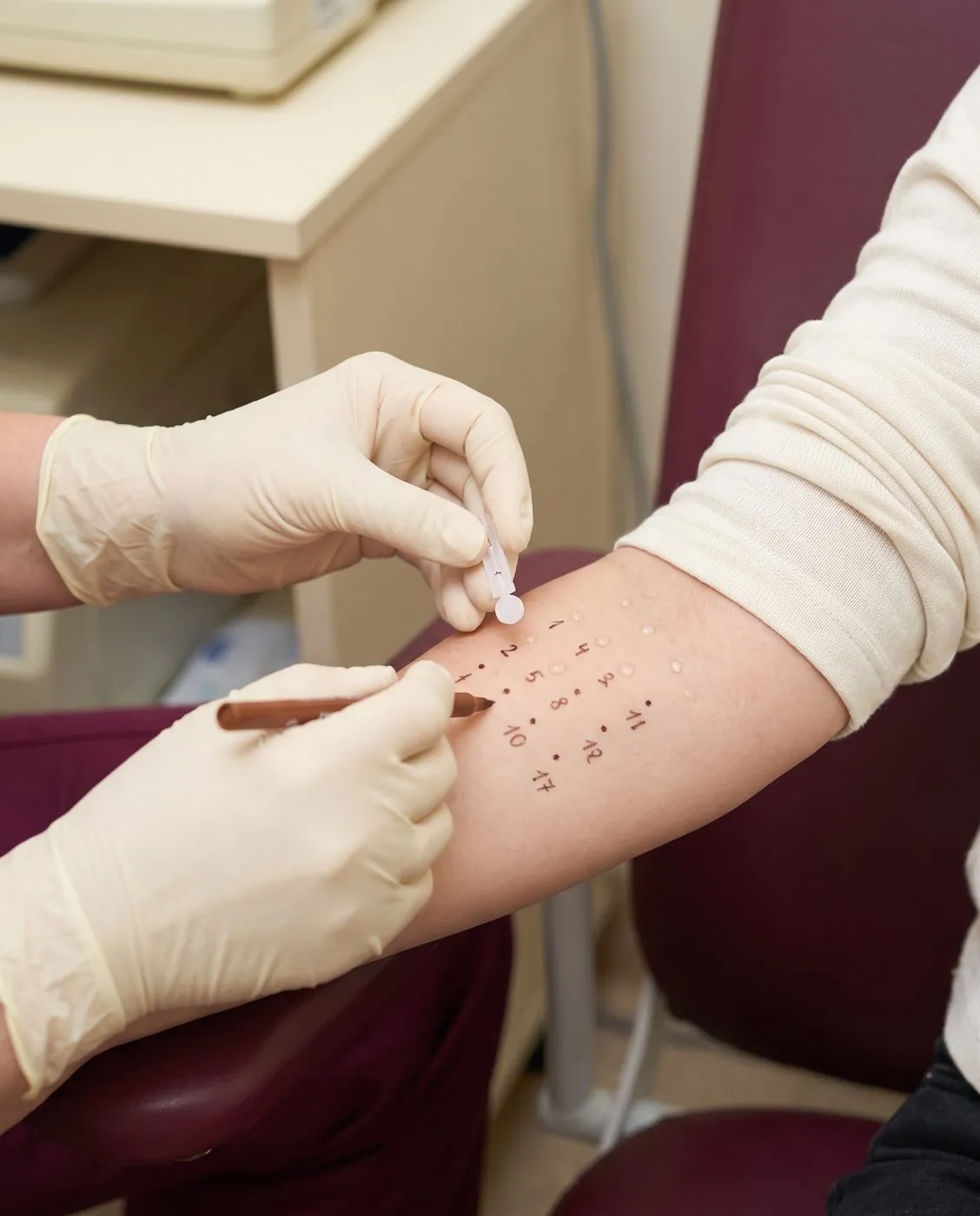

No allergy test is one hundred per cent reliable, which is why the experience of specialists is needed. Before any test, you must have a thorough interview (history) about your symptoms, the course of the allergy, any allergies in the family and the treatments followed so far. The allergy tests are assessed taking all of this information into account. The skin tests, which are relatively simple to carry out and painless, are of two kinds: one with an immediate reaction and one with a delayed reaction.
In the immediate-reaction test (prick test), drops of various allergen solutions are placed on the skin of the forearm and the superficial layers of the dermis are pricked with a special sterile lancet, so that the allergen (protein) comes into contact with the skin cells. The skin of the area chosen for the test is usually the volar surface of the forearms: more precisely 5 cm above the wrist and 3 cm below the antecubital fossa. The test is read after 20 minutes. A positive reaction looks like a mosquito bite. To carry out the prick test it is important not to take antihistamines by mouth (or injection) for at least 5-7 days (depending on the type of antihistamine). All other therapies do not interfere with the test.
The prick test can assess allergic sensitisation to allergens of various kinds:
- Inhalant allergens, such as pollen, house dust mite or pet derivatives, and moulds
- Foods, both of plant and of animal origin
- Latex
- Insect venom (diagnosis of these allergies also includes intradermal skin tests)
- Drugs (diagnosis of these allergies also includes intradermal skin tests)
In the delayed-reaction test (patch test), a patch is applied to the back and the reaction (usually a small eczema) is assessed after one or two days. The patch test is an essential diagnostic tool for diagnosing contact dermatitis. While the test is under way (the 48-72 hours during which the patient wears the patch) it is important not to sweat excessively, not to wet the patch (it could come off) and not to expose the area to the sun. To carry out the patch test, panels made up of various substances (called haptens) potentially responsible for contact dermatitis are used. The panel most commonly used in Italy is the one recommended by the Italian Society of Occupational and Environmental Allergological Dermatology (SIDAPA panel). The panel includes many substances commonly encountered in everyday life, such as metals (nickel, cobalt, potassium dichromate), dyes (para-phenylenediamine, disperse blue, disperse red), substances found in rubber goods (thiuram), in cosmetics (parabens) or perfumes (fragrance mix, balsam of Peru), preservatives (Kathon) and drugs (neomycin, benzocaine). All the haptens are placed in individual cells of non-allergenic material, fixed on a plaster (the patch itself) that must be placed on the skin of the upper back.