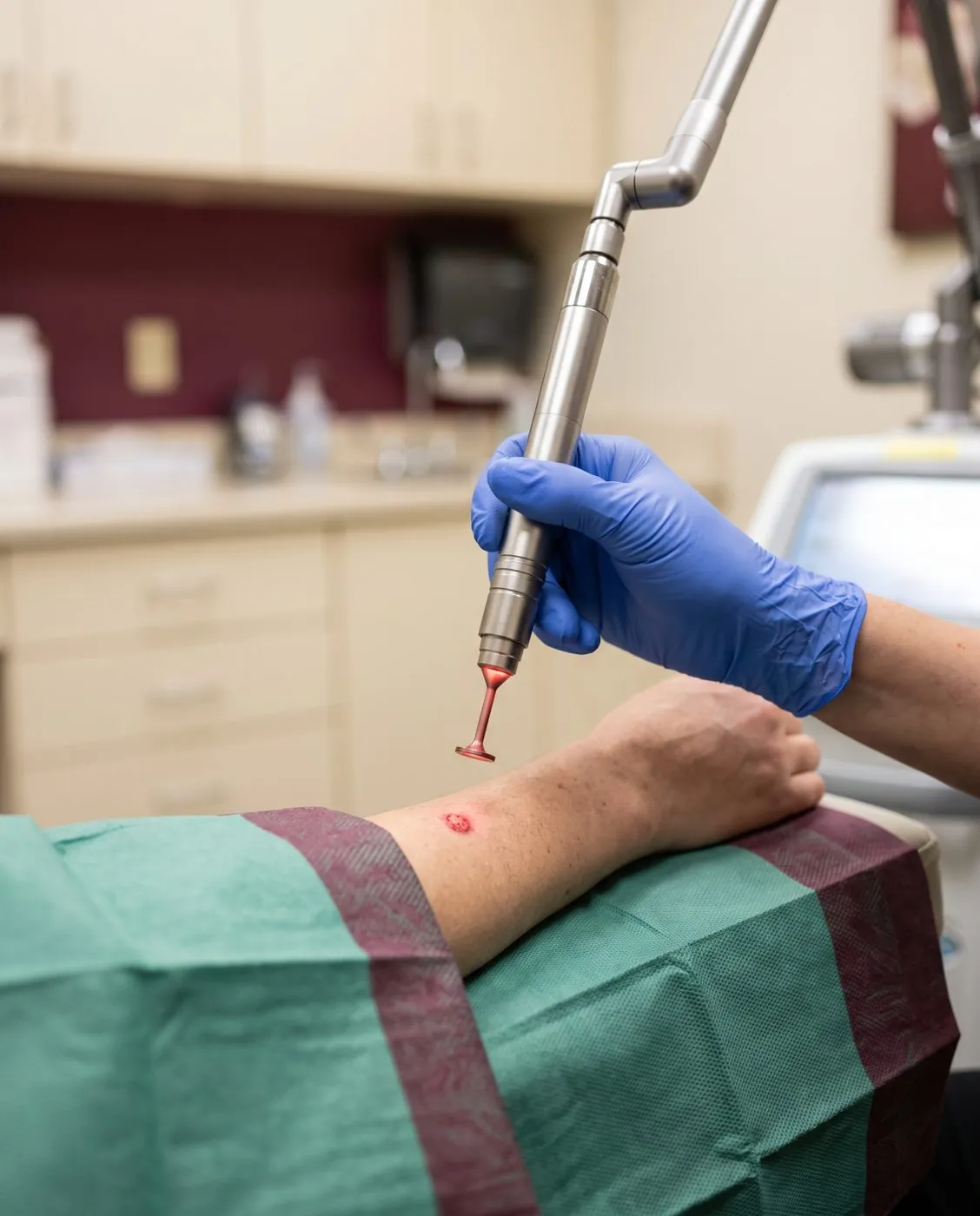

Outpatient surgery is performed for small skin lesions. For more difficult lesions in delicate areas such as the face, a surgical CO₂ laser is used; it is also useful for superficial dermabrasion and for removing small lesions such as fibromas or keratosis.
The pulsed CO₂ laser is a carbon dioxide beam that acts on the water content of cells, vaporising them. The target of the CO₂ laser is therefore the water inside the cells, without damaging or burning the surrounding tissue. The advantages of the CO₂ laser are reduced thermal damage, less bleeding, less inflammation and better healing. It is in fact ideal for very damaged, inelastic skin, because it not only removes the most superficial layers but can also produce a significant contraction of the collagen and elastic fibres in the dermis, making the skin much firmer.
Another advantage of the CO₂ laser is the certainty that the treated areas are always "levelled" to the desired depth.
In aesthetic surgery the CO₂ laser, which is invisible and infrared, has replaced the scalpel in many types of procedure. The CO₂ laser emits radiation in the infrared band that destroys cells by vaporising their water content; the reduced thermal damage and decreased bleeding make it suitable for surgical incisions, where a limited inflammatory response means better healing.
The advantages over the traditional scalpel are: absolute precision, barely visible scars, reduced bleeding and shorter healing times.
The CO₂ laser is often used in place of the scalpel, and also for laser treatments of various blemishes or conditions, such as:
- Superficial peels
- Ablative skin rejuvenation – skin resurfacing
- Lip wrinkles
- Wrinkles around the eyes
- Facial wrinkles
- Warts
- Fibromas
- Condylomas
- Seborrhoeic keratosis
- Acne scars
- Hypertrophic scars
- Removal of small benign growths
- Keratosis
- Rhinophyma
- Skin pigmentation